Why You Need a Christmas Light Timer
Managing Christmas lights manually can be tedious and costly. A Best Christmas Light Timer automatically turns your decorations on and off on schedule, helping you save energy while creating a festive ambiance without the hassle. Whether you’re decorating indoor trees, outdoor displays, or string lights, the right timer ensures your holiday setup runs like clockwork.
Our roundup features {{10}} of the best options currently available, ranging from simple mechanical timers starting at 5.98 to advanced programmable models with remote controls up to 15.99. The average price point sits around 11.24, making quality automation accessible to any budget.
What to Look for in a Christmas Light Timer
- Indoor vs. Outdoor: Outdoor timers must be weatherproof and rated for wet conditions, while indoor options prioritize compact design and safety.
- Mechanical vs. Digital: Mechanical timers are simple and reliable with 24-hour cycles, while digital models offer 7-day programming and more precise control.
- Outlet Configuration: Single or dual outlets determine how many light strings you can control simultaneously.
- Special Features: Look for dusk-to-dawn sensors, remote controls, countdown timers, and heavy-duty ratings for high-wattage displays.
- Safety Ratings: ETL or UL certification ensures the timer meets electrical safety standards.

BN-LINK Mechanical Outlet Timer 2-Pack, 24-Hour Pin Control for Lamps and Appliances
Expand details⌄
Detailed Review
These timers arrive with the pins already pressed down, so the first step is pulling them up to begin programming. The mechanical pin design is straightforward: push pins down for time slots when the device should be on, leave them up when it should be off. Each timer wheel represents a full 24-hour period divided into 30-minute intervals, giving you 48 possible on/off combinations per day. The construction feels solid for the price point, and the compact size means it doesn't block adjacent outlets.
In practice, the mechanical system proves reliable for routine tasks. You can program a lamp to turn on at 6 PM and off at 11 PM every night, then adjust it again for weekends or seasons without any other equipment. The 15-amp, 1875-watt capacity handles standard household lamps and small appliances competently, though higher-draw devices like space heaters or power tools fall outside this timer's range. Since there's no battery backup or app connectivity, settings persist only as long as the device remains plugged in to active power, and programming requires manual physical adjustment each time.
Compared to smart plugs, these mechanical timers eliminate the need for Wi-Fi, smartphone apps, or cloud accounts. That simplicity appeals to users who want basic automation without managing digital ecosystems. The tradeoff is less flexibility: you cannot adjust schedules remotely, set random on/off times to simulate occupancy, or integrate with other smart home devices. For straightforward, repetitive schedules in a single location, the mechanical approach works well and costs significantly less than connected alternatives.
This product suits anyone seeking uncomplicated device automation for a specific room or area. It's particularly useful for holiday decorations, plant watering systems, and rotating appliance usage without the setup complexity of smart home platforms. The two-pack format makes sense for households wanting timers in multiple rooms simultaneously, though each operates independently on its own schedule.
Programming Tips for Maximum Reliability
Start by identifying the 30-minute interval blocks that match your actual schedule. If you want a lamp on from 7 AM to 6 PM, count the pins that correspond to those times rather than guessing. Pull up all pins first to fully reset the timer, then deliberately press down only the pins for your desired on-time window. This prevents accidentally leaving pins down from factory settings or previous programming.
Remember that the timer repeats the same schedule every 24 hours once plugged in. If you need different schedules for weekdays and weekends, you'll need a separate timer for each pattern, or manually reprogram your existing timer twice weekly. For devices that draw near the 15-amp limit, test the timer with the device running to ensure the pins don't slip or the mechanism doesn't heat up, which could signal inadequate capacity.
HBN Outdoor Timer Outlet Waterproof, 24 Hour Mechanical Light Timers for Electrical Outlet...


BN-LINK Outdoor Dusk-to-Dawn Timer with Dual Outlets, Weatherproof 15A
Expand details⌄
Detailed Review
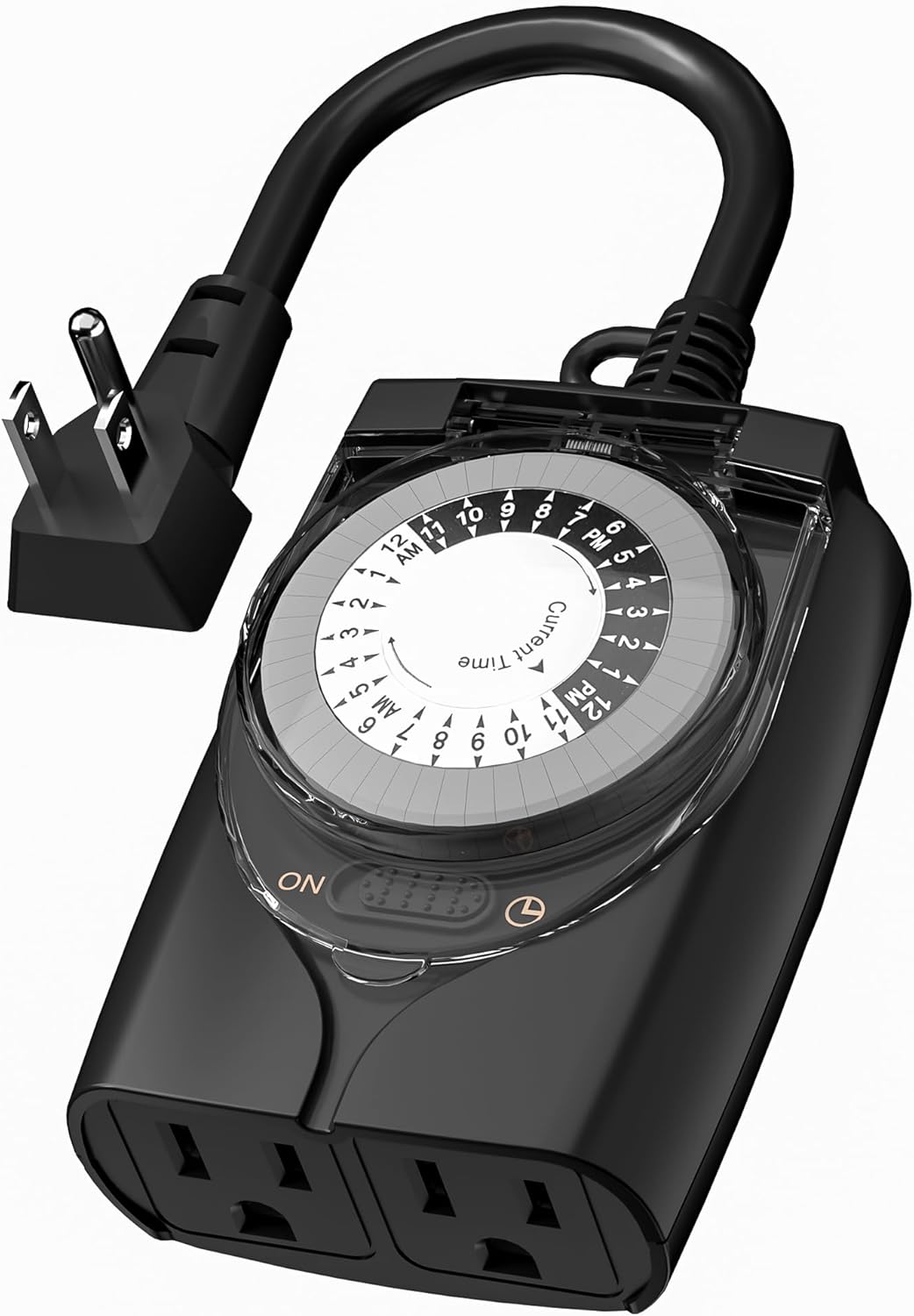
Out of the box, this timer feels straightforward and compact. The dual-outlet design means you can plug in two separate light strings or decoration sets without daisy-chaining cords, and the weatherproof construction appears solid enough for outdoor exposure. The manual dial switch is intuitive: simply turn it to your chosen mode (dusk-to-dawn, or the 2-, 4-, 6-, or 8-hour timed options), and it's ready to work. There's no app, no batteries to manage, and no setup wizard to navigate.
In real-world use, the photocell sensor responds to natural light changes, making it practical for seasonal decorations without daily adjustment. The 15A capacity suits most standard string lights and similar outdoor decorative loads, though heavy-duty equipment or multiple high-wattage devices at once could exceed its rating. The timer reportedly restores its settings after power outages, which means you won't lose your configuration if the power cycles unexpectedly. The heavy-duty PPE material and fire-resistant construction suggest this timer is built to handle outdoor conditions for extended periods.
Compared to other outdoor timers in this price range, the dusk-to-dawn feature with manual timer fallback options covers most casual users' needs without requiring constant interaction or smartphone monitoring. The dual-outlet format eliminates the need for a power strip or surge protector in many setups, simplifying cord management around decorative areas. If you're comparing this to smart home alternatives, you're trading convenience for reliability—no WiFi requirements, no login troubles, and no dependency on cloud connectivity.
This timer works best for anyone who needs a reliable, set-it-and-forget-it solution for seasonal lighting. Homeowners decorating for holidays, gardeners running outdoor string lights, or anyone wanting to automate porch or pathway lighting without smart-home integration will find this practical and dependable. If you need precise scheduling, remote control, or to manage heavy commercial loads, look elsewhere, but for straightforward outdoor automation, this delivers solid value.
Proper Outdoor Installation and Weatherproofing
Installation height and orientation are critical to this timer's longevity. The specified 2-foot minimum height prevents accidental water pooling in the outlets from ground-level moisture or splashing. Always install the unit vertically (not horizontally) so water naturally drains away from the outlets rather than pooling inside. If your outdoor space has persistent dampness or heavy spray (near a pool area or hose line), position the timer further back or consider a weatherproof cover to shield the face dial from direct water impact.
Before the first season, check that both outlets are clear of debris and that the dial moves freely without resistance. Test the outlet by plugging in a simple light and observing the dusk-to-dawn cycle for an evening or two to confirm the photocell is responding appropriately to your location's light levels. If your outdoor area is very shaded or very bright relative to typical settings, you may need to adjust placement or accept slight variance in exact on-off times.

DEWENWILS Outdoor Timer with Remote Control, 2 Outlets, 100FT Range
Expand details⌄
Detailed Review
Out of the box, the DEWENWILS timer feels solidly built for outdoor use. The PBT housing and weatherproof design suggest it can withstand regular exposure to the elements, and the included CR2032 battery means you can start using it immediately without a trip to the store. The 6-inch grounded cord is practical for most standard outlets, and the dual outlets let you control two separate devices simultaneously, which adds flexibility compared to single-outlet timers.
In practice, the timer offers genuinely useful automation options. The preset countdown modes (2, 4, 6, or 8 hours) cover a range of realistic scenarios like running a fountain for a set duration or turning on string lights for an evening. The dusk-to-dawn feature pairs with the built-in light sensor to handle seasonal schedule changes automatically, which is especially valuable for outdoor holiday lighting or landscape lighting that should match daylight hours. The 100-foot remote control range works when line-of-sight is clear, letting you trigger the timer from inside without fumbling with the device itself.
Compared to typical outdoor timers, this model balances convenience with simplicity. Many competing options require manual programming or lack remote functionality, making daily adjustments tedious. This timer's preset options minimize configuration steps, and the remote removes that friction entirely. The high user rating across a large review base suggests durability and reliability over time, which matters in outdoor environments where performance degradation is common.
This timer is best suited for homeowners managing outdoor lighting, pools, fountains, or irrigation systems who want automation without smart-home complexity. If you need to control single devices on basic schedules and value straightforward, weatherproof operation, it delivers on those fronts. It is not the right choice for high-amperage tools or appliances, and RF-heavy environments may require testing the 100-foot claim before final placement.
Remote Control Range in Practice
The 100-foot RF range is measured in line-of-sight conditions, meaning clear air between the remote and the receiver. Windows, wooden doors, and thin walls typically do not block the signal effectively, but metal structures, dense walls, or heavily insulated buildings can reduce effective range significantly. Before mounting the timer in a permanent location, test the remote from your intended control point to verify it functions at the distance you need.
The CR2032 battery powering the remote should last months to over a year depending on usage frequency. When the remote stops responding consistently, replacing the battery solves the issue in seconds. Keep a spare CR2032 on hand if you rely on the remote function regularly, as this timer does not have a corded manual control option as a backup.


BN-LINK Indoor Digital Light Timer, 7 Day Programmable Plug with 2 Independent 3-Prong Out...

TiFFCOFiO Mechanical Outlet Timer 2-Pack: 24-Hour Programmable Control
Expand details⌄
Detailed Review
Out of the box, the timer feels solid and straightforward. The compact form factor with output ports positioned underneath means it won't monopolize your outlet space or stick out awkwardly from the wall. The mechanical design is immediately intuitive: there are no batteries to replace, no smartphone app to download, and no confusing menus to navigate. Instead, you simply pull pins up for OFF periods and push them down for ON periods on a 24-hour dial divided into 48 time slots. This simplicity makes setup quick and reliable.
In practical use, the 30-minute interval granularity covers most common applications well. For Christmas lights, outdoor outlets, aquarium pumps, or fans that run on predictable schedules, this level of precision is more than adequate. The daily repeat function means once you set your schedule, it runs the same cycle every day without further input. Since there are no digital displays or batteries, there is no power-loss setup recovery needed either. The mechanical pins stay where you left them, so brief power outages won't reset your configuration.
Compared to budget digital timers, this model trades flexibility for reliability and ease of use. Digital timers offer finer minute-level control and sometimes remote features, but they require batteries or power management and can be finicky to reprogram after interruptions. This mechanical approach eliminates those pain points entirely. The two-pack format also provides better value if you need to automate multiple outlets around your home or yard. The ETL certification gives confidence that safety standards have been met for indoor use.
This timer works best for people who want set-it-and-forget-it automation without learning a new interface or worrying about battery replacements. Seasonal users managing holiday lights, homeowners controlling outdoor water features, or anyone automating routine household appliances will find it reliable and hassle-free. If you need precise minute-level timing or remote smartphone control, a digital timer would be more suitable, but for straightforward daily schedules, this mechanical design delivers solid functionality.
Programming and Maintenance Tips
The pin-based programming works best when you map out your schedule before starting. Write down what time each ON and OFF period should occur, then translate that into the 48 time slots. Each pin represents a 30-minute block, so a device running from 6:00 AM to 10:00 PM would require 28 consecutive pins in the down position. Take your time setting the pins the first time; it only takes a few minutes and eliminates scheduling mistakes.
Keep the timer away from moisture and avoid inserting and removing plugs repeatedly from the same outlet socket, as this can loosen the mechanical connection over time. If the pins become sticky or difficult to adjust after months of use, a small amount of silicone-based lubricant on the pin mechanism can help restore smooth operation. Store the spare unit in a dry location if you're not using it immediately, and check the ETL marking to confirm your unit matches what was advertised.

GE 24-Hour Mechanical Outlet Timer for Indoor Lighting and Holiday Decor
Expand details⌄
Detailed Review
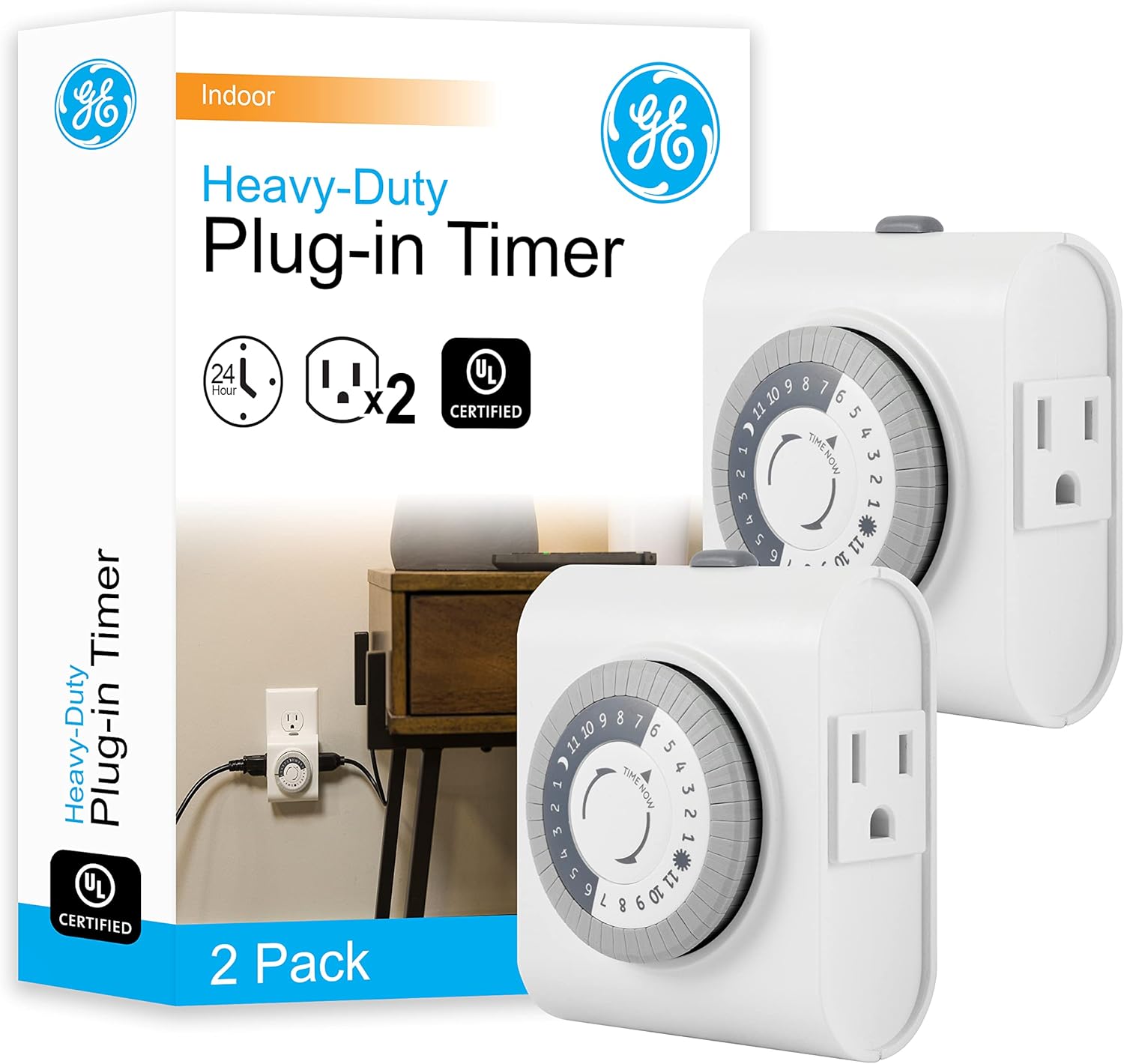
Out of the box, this timer feels appropriately basic and intentional. The white finish is unobtrusive, and the compact footprint means it doesn't monopolize your outlet space the way some plug-in devices do. The side-access outlet keeps connected cords running flush against the wall, which matters if you're tucking it behind a nightstand or dresser. The manual dial is clearly marked with 24-hour intervals, and the pushpin system for setting on/off times is straightforward—no batteries, no app pairing, just physical pins you set into the dial at 30-minute marks.
In real-world use, a mechanical timer does exactly what you'd expect: it turns on and off on schedule, repeatedly and without fail. This reliability is its main appeal for routine tasks like turning on a lamp at dusk or cycling a small fan during the day. The built-in override switch lets you manually bypass the schedule when needed without resetting your program, which is genuinely practical for those moments when you want to deviate from your routine. The 30-minute interval granularity is coarse enough that precise timing isn't possible, but for most indoor lighting and seasonal décor applications, this isn't a problem. The durable construction suggests this isn't a throwaway device—mechanical timers have no moving parts to repair or wireless components to fail.
Compared to smart plugs or Wi-Fi-enabled timers, this mechanical alternative trades flexibility for simplicity and independence. You sacrifice the ability to adjust schedules from your phone, but you gain a device that requires no app, no internet connection, and no account management. For people who simply want their holiday lights to come on at the same time every evening through December, or for renters who can't install permanent lighting fixtures, a mechanical timer delivers exactly the right amount of control. The constraint of a single polarized outlet means you're limited to one device per timer, so apartment dwellers or those with minimal spare outlets may find this limiting.
This timer makes the most sense for users who prioritize simplicity over sophistication. If you're planning seasonal decor that runs the same daily schedule for weeks, or if you want to automate a lamp for energy savings without fussing with technology, this is a logical choice. It's equally suitable for people who specifically avoid smart-home systems or who live in areas with unreliable internet. However, if you need simultaneous control of multiple devices or precise minute-level scheduling, you'll need multiple timers or a different product altogether.
Setting Up Your Schedule Without Mistakes
The 30-minute interval pins are the core of this timer, so understanding how to use them matters. Each pin slot represents a 30-minute block across the 24-hour dial. Pushing a pin inward activates that time slot; leaving it out keeps the device off. The key is visualizing your full day: if you want your lamp on from 6 PM to 11 PM, you'll need to push in pins for twelve consecutive slots (6 PM through 10:30 PM). This isn't difficult, but it does require thinking in 30-minute chunks rather than exact times.
Placement is equally important to scheduling. Because this is a plug-in device, it occupies a wall outlet that might otherwise serve another purpose. The side-access outlet helps—it directs the connected device's cord parallel to the wall rather than jutting outward—but you'll still want to position the timer somewhere that doesn't interfere with other plugged-in devices or create a crowded outlet cluster. Avoid outlets near water sources or in high-traffic areas where the device could get bumped or unplugged accidentally.
Starting with a simple one-cycle schedule (one on period and one off period per day) is the easiest way to verify everything works before programming multiple daily cycles. Once you confirm the first cycle operates correctly, you can add additional pin patterns if your use case calls for it. Remember that the manual override switch is your safety valve if something goes wrong or you need to interrupt the schedule—you don't need to remove pins to temporarily disable the timer.
How to Choose the Right Timer for Your Needs
If you have a simple indoor setup, a basic mechanical timer like the GE single-outlet option offers reliable performance at the lowest price point. For outdoor displays, prioritize weatherproof models with dual outlets to maximize your decoration coverage.
Digital programmable timers give you the most flexibility, allowing different on/off times for each day of the week—perfect for varying your display schedule. If you want hands-free convenience, consider models with dusk-to-dawn sensors that automatically adjust to seasonal sunset times.
For larger displays with multiple light strings and accessories, look for timers with remote controls or countdown features, which let you manage everything without physically accessing the outlet. Heavy-duty ratings (1/2HP or higher) ensure the timer can handle high-wattage loads safely.
Installation and Safety Tips
Before purchasing, verify your outlet type and wattage requirements. Most timers accommodate standard grounded outlets, but always check compatibility. Position outdoor timers in sheltered locations away from direct water spray, and ensure indoor timers have adequate ventilation. Test your timer setup before the holiday season begins to confirm proper scheduling and functionality.