Why You Need a Digital Light Timer
A Best Digital Light Timer is one of the most practical investments you can make for your home. Whether you’re looking to automate your morning coffee routine, create the illusion of occupancy while on vacation, or manage holiday decorations, these devices offer convenience and energy savings without breaking the bank.
Digital timers work by plugging into your outlet and allowing you to schedule when connected devices turn on and off. They’re ideal for lamps, fans, coffee makers, aquariums, grow lights, and more. With options ranging from simple 24-hour models to sophisticated 7-day programmable units, there’s a timer for every situation and budget.
What to Look for in a Digital Light Timer
- Programmability: Choose between 24-hour basic timers or 7-day models with multiple on/off settings for more complex schedules
- Outlet Configuration: Single or dual outlets affect how many devices you can control simultaneously
- Durability: Indoor models are standard, but outdoor timers must be weatherproof for exposed installations
- Power Rating: Ensure the timer can handle your device’s wattage (typically 1000W–1875W)
- Installation: Plug-in timers are easiest; in-wall models offer a seamless look
- Advanced Features: Vacation mode, battery backup, and astronomic controls add convenience
Our Top {{10}} Picks
We’ve selected the best digital light timers across multiple categories, with prices ranging from 8.96 to 70.54. Whether you need a budget-friendly basic timer or a premium smart solution, this roundup covers the {{10}} standout options for 2026.

BN-LINK Indoor Digital Light Timer, 7 Day Programmable Plug with 2 Independent 3-Prong Out...

DEWENWILS Programmable 24-Hour Digital Timer Outlet (2-Pack) for Lamps & Small Appliances
Expand details⌄
Detailed Review
Out of the box, this timer feels lightweight and straightforward. The compact profile means it doesn't crowd the outlet strip or wall socket—a practical design choice that sets it apart from older, bulkier timers. The frosted front and smooth edges give it a modern look that doesn't clash with home decor. The digital display is large enough to read without squinting, and the four-button interface for programming is reasonably intuitive, though you'll want the manual handy the first time you set it up.
In regular use, the timer performs its core job reliably. You can stack three separate daily schedules—say, one for morning lamp activation, another for an evening routine, and a third for an always-off state—without needing multiple units. The silent operation is genuinely useful in bedrooms where clicking or humming would be distracting. The standby power draw appears minimal, which supports the energy-saving claim. If you lose power, the timer remembers your settings for up to three months, so you won't need to reprogram after a brief outage.
Compared to similar programmable outlets, this model strikes a reasonable balance between simplicity and flexibility. It's more capable than bare-bones on-off timers but less complex than WiFi-enabled smart plugs that require app setup and internet connectivity. The two-pack format offers decent value if you want automation in multiple rooms, though each unit controls only one device at a time. The 15-amp, 1000-watt limit is standard for this category but rules out high-draw appliances like space heaters or large air conditioners.
This timer works best for anyone automating seasonal decorations, plant lights, fans, or aquarium equipment—anything in the 1000-watt range that benefits from consistent daily schedules. It's less suited for tech-forward users who prefer smartphone control or for households needing to operate multiple high-power devices simultaneously from a single timer.
Programming and Troubleshooting Basics
Start programming by selecting which of the three daily schedules you want to edit using the mode button, then use the up and down arrows to set the on time, off time, and repeat frequency. Once set, the schedule repeats automatically every 24 hours. If you make a mistake midway through, simply return to that schedule slot and overwrite it—there's no confirmation step, so double-check before finalizing.
If the display goes blank or stops responding after a power outage, unplug the timer for 30 seconds, then reconnect it. Your programmed schedules should reappear automatically. If the timer isn't turning your device on or off at the expected time, verify the outlet clock matches your actual local time—the clock can drift slightly and may need manual adjustment every few weeks, particularly if power interruptions are frequent.

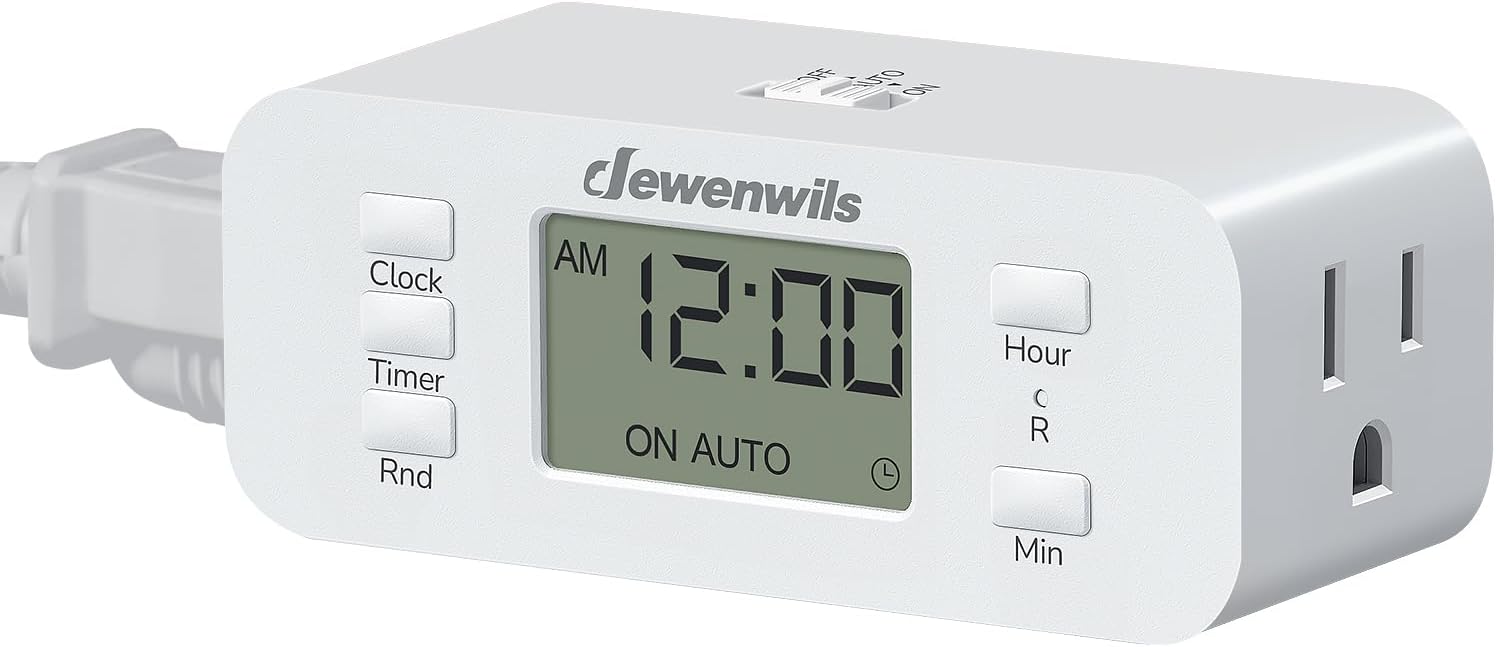
DEWENWILS 24-Hour Programmable Timer Outlet: Daily Scheduling with Dual Outlets
Expand details⌄
Detailed Review
Out of the box, the timer feels solid and compact enough that it won't monopolize adjacent outlets on a standard power strip. The matte finish and smooth side edges give it a less utilitarian look than many mechanical timers, and the dual outlet design means you can control two devices or split a single load. The large display is genuinely readable from a distance, which matters if you need to confirm settings at a glance from across a room.
Setting up the three daily events is straightforward using the five buttons and the side mode selector. The random security feature, which varies on/off times slightly, does its job of simulating occupancy without requiring manual adjustment each day. Where this timer excels is reliability in routine tasks: turning on a grow light at 6 AM and off at 10 PM, or cycling an aquarium filter three times daily. The silent operation is a real advantage over mechanical clickers, especially in bedrooms or home offices where ticking would become irritating. The memory function that preserves your schedule for up to six months after unplugging is particularly useful if you travel or experience intermittent power issues.
Compared to other programmable outlets at this price point, the dual-outlet design and large display are practical strengths. You lose nothing by choosing this over single-outlet alternatives, and you gain flexibility. The 15A/1000W limit is typical for consumer timer outlets and handles most household items, though high-draw devices like space heaters or air conditioning units fall outside its range. The three-event limit is workable for most daily routines but not ideal if you need more complex scheduling like multiple on/off cycles throughout the day.
This timer is best suited for people with predictable daily needs: someone who wants to automate holiday decorations, manage aquarium lighting, control a reptile heat lamp on a fixed schedule, or ensure a fan runs during set hours. It rewards straightforward use cases and simple routines, making it a no-fuss choice for automating repetitive tasks without investing in a smart home system.
Maximizing the Memory Function
The six-month memory backup means your program survives most power outages without needing reset, a genuine convenience during storms or utility work. To keep schedules intact longer, avoid unplugging the unit frequently for storage. If you do need to relocate it, you have a six-month window to plug it back in before losing your settings. Plan any major power maintenance (changing circuits, outlet replacement) with this timeline in mind so you don't lose your schedule halfway through a season.
When first setting the three daily on/off events, test them with a low-risk device like a lamp before connecting critical equipment. This lets you verify the exact timing without risk. For seasonal use, punch in your schedule once at the start of the season and leave it alone. The daily repeat function means no reprogramming next week or next month, so that initial setup really does pay off in time savings if you use the same schedule repeatedly.

Fosmon 24-Hour Digital Outlet Timer, 15A Programmable Plug-In Switch
Expand details⌄
Detailed Review
The Fosmon timer arrives as a straightforward rectangular plug-in unit that fits the profile you'd expect at this price point. The compact design means it occupies minimal space on a power strip or outlet, though depending on your outlet placement and neighboring plugs, it might crowd adjacent slots. The face includes a small LCD display and tactile buttons for navigation, giving it a no-frills appearance that prioritizes function over aesthetic refinement.
In daily use, the timer handles routine scheduling tasks without complaint. The 15A/1875W capacity is sufficient for most household items like desk lamps, small fans, and even many grow light setups, so power limitations rarely become an issue for typical applications. The two on/off program slots allow you to set a morning activation and evening shutoff, or create separate weekday and weekend patterns by staggering times across the two slots. The 738 customer reviews averaging 4.20 stars suggest the device generally maintains its settings and operates consistently, which is the baseline expectation for any timer.
Compared to other entry-level outlet timers in this category, the Fosmon offers standard functionality without extra complexity. You get the essential scheduling capability without smartphone connectivity, cloud features, or advanced programming modes, which keeps both the cost and learning barrier low. This means fewer bells and whistles than pricier digital timers, but also fewer opportunities for connectivity failures or app-related frustration. For someone who needs simple, reliable timing without ongoing tech support, this trade-off makes practical sense.
This timer works best for straightforward, recurring schedules: turning a grow light on at dawn and off at midnight, automating a fan during specific hours, or gating lamp usage to certain times of day. It is a solid fit for renters, budget-conscious households, or anyone testing whether automation would actually benefit their routine before investing in smarter home technology. Those needing more than two independent programs or wanting remote control from a smartphone will want to explore other options.
Programming Your Timer Effectively
The two on/off slots are the key constraint to understand upfront. Rather than thinking of them as two separate timers, treat them as one flexible schedule: you can set slot one to turn power on at 6 a.m. and off at 10 p.m., then leave slot two dormant, or activate slot two to add a secondary cycle on the same day. Some users find it helpful to use one slot for weekday timing and manually override on weekends, while others program both slots with overlapping times to create a more complex pattern.
Button navigation takes a few minutes to master, so budget extra time during initial setup rather than rushing through the manual. Once programmed, most users report the timer holding its settings reliably through power outages and extended use, so reprogramming is rare. Keep your power outlet easily accessible so you can manually adjust the plug in and out position if needed for maintenance or reprogramming.
Placement matters: plug it into a power strip or directly into a wall outlet with good access, and consider whether the plug body will interfere with an adjacent outlet. This minor physical constraint doesn't affect performance but can affect convenience if you're managing several devices in one surge-protected strip.

BN-LINK 7-Day Digital Timer Outlet with Dual Grounded Plugs & Vacation Mode
Expand details⌄
Detailed Review
Out of the box, this timer feels like a straightforward tool. It is compact enough to fit behind most furniture without taking up significant wall space, and the dual-outlet design means you can program two different devices simultaneously or run both on the same schedule. The 3-prong grounded outlets suggest adequate safety standards. Setup is designed to be quick; the existing description emphasizes that users can pick from preset combinations or customize days individually, and the device automatically adjusts for daylight saving time, which removes one potential source of frustration.
In real-world use, the core job of this timer is to turn things on and off reliably. With up to 8 separate on/off schedules per day and schedules as short as one minute, it covers most household timing needs. Whether you are running a lamp on a sunset-to-bedtime cycle, keeping a coffee maker running during weekday mornings, or managing a ventilation fan in a humidity-prone room, the programming flexibility is there. The vacation mode with randomized timing is a practical security feature; rather than creating an obvious pattern, it varies when lights turn on and off to make a home appear occupied. At 15A/1875W for resistive loads, it handles standard household items, though heavy-draw appliances, high-powered space heaters, and motor-driven equipment like large air conditioners fall outside its operating range.
Compared to other basic outlet timers in this category, the dual-outlet layout and eight-program capacity are genuine conveniences that justify this product's position. Single-outlet timers are cheaper but inflexible when you want to control multiple devices. Smart plugs offer remote access and voice control but cost significantly more and require WiFi and a compatible ecosystem. This timer sits in the practical middle: it costs very little, requires no subscription or internet, and delivers enough programmability for most users who simply want predictable scheduling and vacation-time peace of mind. The 4.30 rating across 393 reviews suggests typical users find it meets expectations for this price range.
This timer is ideal for renters or anyone wanting straightforward, silent automation without setup complexity. It works well for lighting routines, energy-conscious appliance management, and creating the illusion of home occupancy. If your needs involve smart home integration, remote scheduling from your phone, or very high power draw, look elsewhere. For uncluttered scheduling control at a single-digit price, this device delivers reliable fundamentals.
Load Compatibility and Wattage Limits
The 15A/1875W rating for resistive loads is the most practical starting point when deciding if this timer fits your device. Resistive loads include incandescent lights, heaters, and heating elements where power draw is straightforward. If you are timing an LED lamp array or a small coffee maker, you are well within safe territory. If you are considering it for a space heater, window unit air conditioner, or high-end hair dryer, you may exceed the limit and risk overload.
The timer also lists reduced capacity for tungsten loads (10A/1250W) and compatibility with 1/2 HP motors, which covers smaller fans and some water pumps but not major appliances. Before plugging in an unfamiliar device, check the wattage on its nameplate; add up all devices plugged in simultaneously and confirm they stay under the 1875W ceiling. Exceeding this rating does not mean the timer will fail catastrophically, but it increases the risk of overheating and potentially tripping the outlet or damaging the timer internally.


myTouchSmart 24-Hour In-Wall Digital Timer with Battery Backup and Dual Programs
Expand details⌄
Detailed Review
This timer installs directly into your existing light switch box, replacing the switch entirely. The compact screw terminal design means it fits neatly in standard wall boxes without the bulk of older models with flying leads. The blue LED indicators next to each button clearly display which programs are active, making it easy to see your automation status at a glance. The interface feels straightforward once installed, with dedicated buttons for each of your two daily programs plus two manual override buttons for when you need immediate control outside your schedule.
In practice, the timer delivers what it promises. Two independent on/off schedules running on a 24-hour cycle handle most everyday needs, whether you're automating evening porch lights, morning bathroom fans, or creating the appearance of an occupied home while traveling. The minute-level precision lets you dial in exact timing, and the battery backup with blue LED indication gives genuine peace of mind during power outages, ensuring your schedules survive the disruption without manual reprogramming. The electrical rating of 15 amps and 1200 watts covers standard household lighting and fans, though it won't work with higher-amperage circuits.
Compared to typical in-wall timers in this price range, the addition of two manual override buttons is genuinely useful. Many alternatives force you to wait for the next scheduled time or bypass the timer entirely, whereas this product lets you temporarily deviate from your program without losing your settings. The support for dimmable LEDs and CFLs, not just standard bulbs, is practical for homes transitioning to modern lighting. However, the two-program limit means this timer isn't designed for households needing multiple different schedules throughout the day.
This product is ideal for someone who wants reliable, set-it-and-forget-it automation without smartphone control or recurring subscription fees. Homeowners new to hardwired timers will appreciate the straightforward button interface, while those with renovation experience won't struggle with the screw terminal installation. The main requirement is verifying you have a neutral wire at your switch box before purchasing, since installation becomes impossible without one. If your electrical setup includes that neutral wire, this timer offers dependable, no-fuss scheduling that justifies its position as a highly-rated option in the basic timer category.
Installation Compatibility Checklist
Before ordering, confirm your switch box includes a neutral wire (a white conductor, separate from the hot and ground wires). Many older homes or certain circuits lack neutral wires at the switch location, making this timer impossible to install. If you're unsure, a qualified electrician can verify this in minutes. The timer requires 120VAC 60Hz power, standard in North American residential circuits, but check that your specific circuit isn't a specialized 240V line.
The screw terminal design requires you to transfer three wire connections (hot, neutral, and ground) from your existing switch to the timer. This is more manageable than older designs with flying leads, but does demand basic comfort with electrical connections. You'll need a wall plate separately, as none is included, so budget for that addition when ordering. The timer itself fits standard single-gang wall boxes, but verify your box has enough depth if it's recessed or packed with other wiring.

Intermatic ST700W Ascend 7-Day Programmable Timer with Astronomic Control
Expand details⌄
Detailed Review
The Ascend timer arrives ready to install into a standard wall outlet box, with a compact footprint that fits neatly between typical indoor spaces. The white finish and modern appearance blend well with contemporary home interiors, and the large backlit LCD screen is genuinely readable without strain. The tactile interface for programming feels responsive, and the menu-driven setup suggests Intermatic has prioritized usability over minimalist design.
Where this timer stands out is its astronomic function, which calculates local sunrise and sunset times and adjusts lighting automatically. Rather than setting fixed on/off times year-round, the device responds to seasonal daylight changes, reducing wasted energy during months with extended daylight. The 42-event-per-week capacity gives real flexibility—you can program different schedules for weekdays and weekends, or layer multiple on/off cycles throughout a single day if needed. The automatic DST correction prevents the manual resetting that plagues older timers, a meaningful quality-of-life improvement for hands-off operation.
Compared to basic mechanical timers or simple digital models with fixed schedules, the Ascend delivers substantially more sophistication. The astronomic feature alone justifies the price for anyone managing outdoor lighting in climates with significant seasonal variation. The 4.60 rating across 212 reviews reflects consistent satisfaction from users who value accuracy and convenience. The non-replaceable battery backup preserves settings during outages, though this design choice means eventual replacement of the entire unit rather than just swapping a battery.
This timer makes the most sense for homeowners with permanent outdoor lighting installations—porches, pathway lights, driveway fixtures—where the wall-mounted design is practical. The astronomic scheduling delivers real value for gatehouses, patios, or security lighting where precision matters. It's less useful for temporary setups or portable applications, and the requirement to purchase a face plate separately adds a small unforeseen cost.
Programming Strategy for Seasonal Lighting
The 42-event maximum is powerful only if used thoughtfully. Rather than programming individual events for each day, consider leveraging the 7-day cycle with repeating schedules: one pattern for winter months and another for late spring through early fall. This approach lets you reset the timer twice yearly rather than constantly tweaking events as daylight shifts. The astronomic function handles the heavy lifting; your manual programming should focus on layering multiple cycles if you need lights at different times throughout the day.
Since the device adjusts automatically for DST and calculates local sunrise/sunset times, you must input your geographic location during setup. Verify this information carefully, as incorrect latitude/longitude data will throw off the astronomic calculations—the whole value proposition depends on accuracy here. The battery backup preserves these location settings through power failures, ensuring the timer resumes correct operation without manual reconfiguration.
Plan for the face plate as a separate purchase when budgeting. The timer itself installs into the wall box, but finishing it with an appropriate trim ring or cover plate is essential for a polished appearance and proper electrical compliance. Factor this into your total project cost before ordering.

DEWENWILS 24-Hour Programmable Timer Outlet | 3 Daily Schedules, Backup Battery
Expand details⌄
Detailed Review
The timer arrives as a straightforward plug-in outlet with a frosted front face and clean side button controls. Setup is immediate: plug it in, and the digital display activates. The compact form factor actually matters here because it sits flat against the wall without blocking adjacent outlets or creating a bulky extension, a real consideration if your outlets are tightly spaced. The 4-button interface takes some deliberation to navigate the first time, but once you grasp the rhythm of setting schedules and toggling between Always On, Auto, and Always Off modes, adjustments become routine.
In practice, this handles the automation it promises reliably. Whether powering an aquarium circulation pump, a reptile tank heating pad, or seasonal decorations, the timer switches on and off precisely at your scheduled times. The silent operation is genuinely useful in bedrooms or other quiet spaces, eliminating the tick or hum some older timers produce. The backup battery deserves mention: if a power outage occurs, your three daily schedules remain intact for up to three months, sparing you from reprogramming when service restores. The 15A/1000W rating covers most household lamps, small fans, and tank equipment, though anything energy-intensive will max it out or exceed it.
Compared to basic on-off timers, the three independent daily programs add significant flexibility, letting you create morning, afternoon, and evening cycles within a single day. Most competing timers at this price point either offer fewer schedules, lack backup battery function, or take up more space. The trade-off is that you control only one outlet and cannot chain multiple schedules for different devices on the same plug. For simple need like one automated task per device, this design works well; for households that need to time multiple appliances independently, you'd need multiple outlets or a larger power strip timer.
This timer suits anyone automating a single device with variable daily needs: aquarium owners managing light cycles, reptile keepers automating heat, plant enthusiasts running grow lights on a schedule, or anyone wanting their home to look occupied while away. It simply does its job without fuss, occupying minimal real estate and keeping your programmed routine intact even when the power fails.
Programming Multiple Schedules Efficiently
Setting three separate daily schedules may feel tedious the first time, but the interface logic remains consistent once you learn it. Each schedule is independent, meaning if you want your aquarium light on at 8 AM and off at 6 PM one schedule, then another lights both at 2 PM and 4 PM, you set those as separate programs. The side switch lets you toggle between viewing and editing each one without losing your entries.
For devices that simply need to be on or off continuously, use the Always On or Always Off mode to skip unnecessary scheduling entirely. The backup battery means reprogramming is rarely necessary; if power returns within three months, your settings survive intact. For longer outages or if you move the outlet between rooms, note down your three preferred schedules before disconnecting it so you can reload them quickly.
Final Thoughts on Choosing Your Digital Light Timer
The best Best Digital Light Timer depends on your specific needs. If you’re on a tight budget, basic 24-hour models deliver reliable performance at unbeatable prices. For more complex scheduling—especially if you want different on/off times for each day of the week—a 7-day programmable timer is worth the investment.
Outdoor enthusiasts should prioritize weatherproof models, while those managing multiple devices benefit from dual-outlet configurations. If you want the ultimate in convenience and don’t mind spending more, in-wall timers with advanced features like astronomic control and battery backup provide premium automation.
No matter which model you choose from our selection, you’ll enjoy greater control over your home’s energy consumption and daily routines. Start automating today and experience the difference a quality digital timer can make.